
Event Details
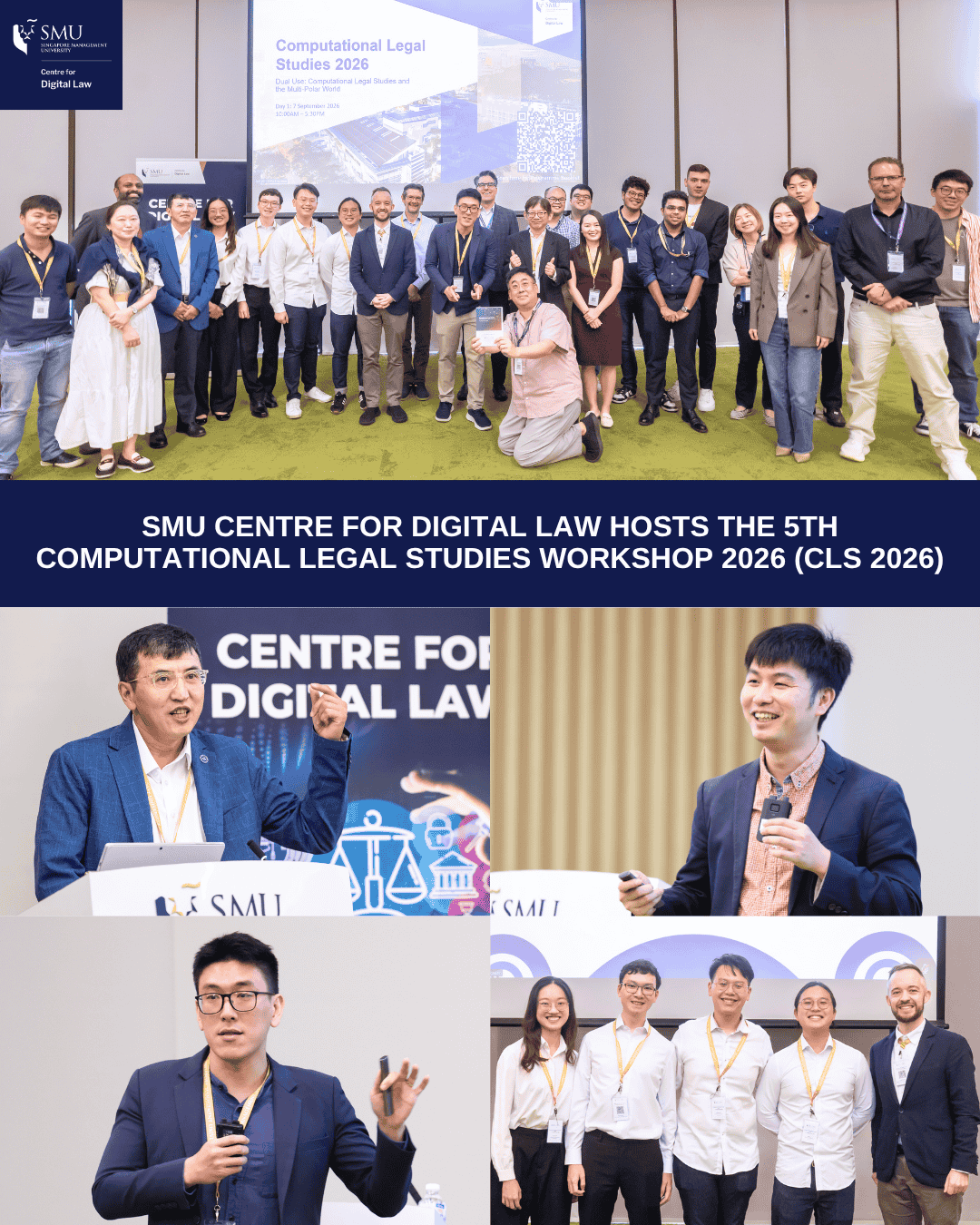
SMU CDL hosted the 5th Computational Legal Studies Workshop 2026 (CLS 2026) at the SMU Yong Pung How School of Law on 7 and 8 September 2026, bringing together scholars and industry participants to explore how computational techniques, including AI, machine learning, and network science, can be used to study and practice law.
CLS 2026 was again held in hybrid format and formed part of TechLaw.Fest’s Day 0 programme. This year’s workshop was themed “Dual Use: Computational Legal Studies and the Multi-Polar World”, inviting participants to reflect on key dualities shaping the field, including symbolic logic and statistical inference, open and closed source, academic and commercial use, conference and journal papers, and AI and law.
Day One centred on research-led inquiry into the methods, applications, and limits of computational legal studies. The programme opened with a keynote address by Prof Altangerel Chagnaa (The National University of Mongolia), who examined language processing in Mongolian legal texts. The day also featured presentations on legal AI evaluation, computational law, AI governance, digital public infrastructure, and computational approaches to regulatory and judicial analysis.
Day Two shifted towards applied research and the translation of computational methods into legal and regulatory practice. Assoc Prof Benjamin Chen (The University of Hong Kong) delivered a keynote on how arguments, models, and evaluation can be more effectively aligned in computational law. The day also featured presentations on legal informatics, legal data, AI governance, automated decision-making, data protection, copyright, agentic AI, and empirical legal research.
We extend our sincere thanks to all speakers, presenters, and participants for contributing to two days of interesting and enlightening conversations on the future of computational legal studies. We are also grateful to our faculty members involved in planning the workshop, Asst Profs Jerrold Soh and Dirk Hartung.
Through initiatives such as CLS2026, SMU CDL continues to advance meaningful academic exchange at the intersection of law, technology and computation, while fostering dialogue between researchers, practitioners and industry on the evolving role of computational methods in legal scholarship and practice.